| 書(shū)目名稱(chēng) | Geometry of Deep Learning | | 副標(biāo)題 | A Signal Processing | | 編輯 | Jong Chul Ye | | 視頻video | http://file.papertrans.cn/384/383804/383804.mp4 | | 概述 | Covers recent developments in deep learning and a wide spectrum of issues, with exercise problems for students.Employs unified mathematical approaches with illustrative graphics to present various tec | | 叢書(shū)名稱(chēng) | Mathematics in Industry | | 圖書(shū)封面 | 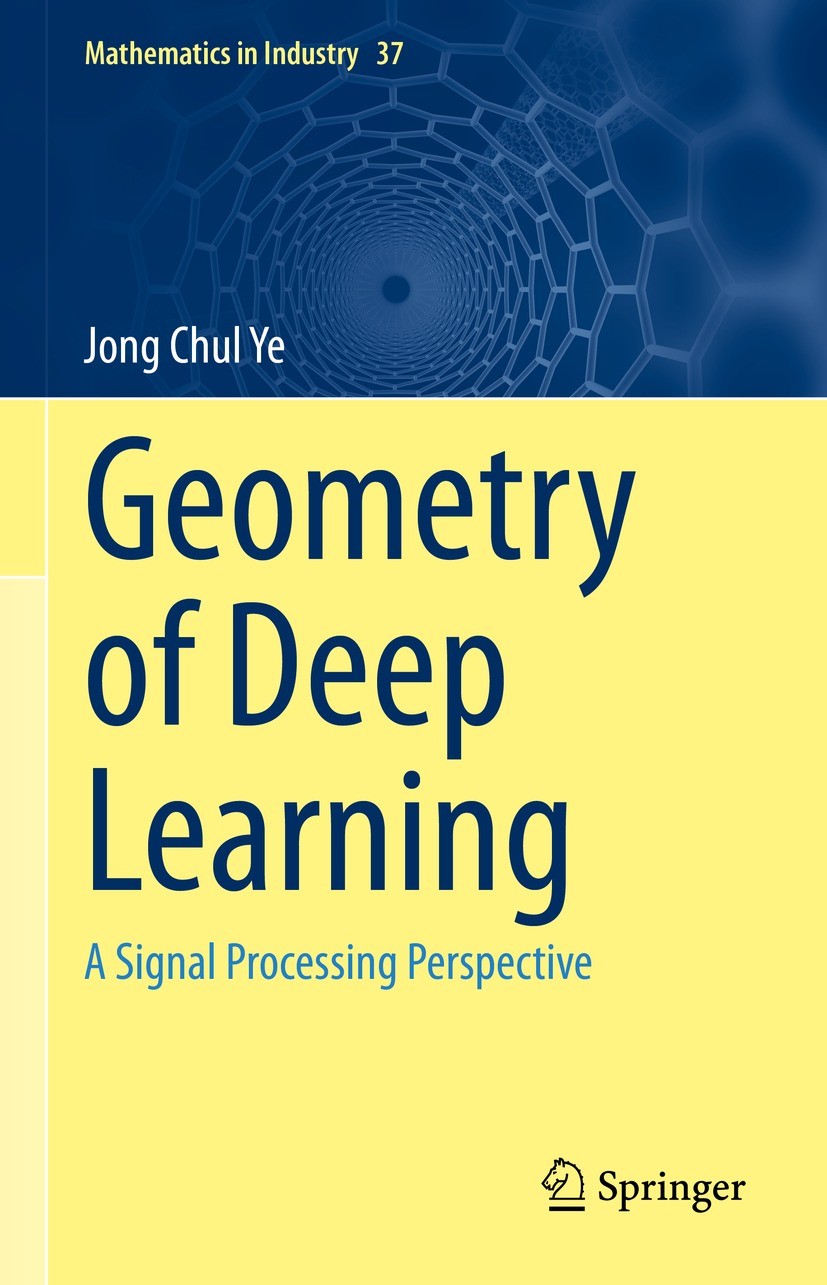 | | 描述 | .The focus of this book is on providing students with insights into geometry that can help them understand deep learning from a unified perspective. Rather than describing deep learning as an implementation technique, as is usually the case in many existing deep learning books, here, deep learning is explained as an ultimate form of signal processing techniques that can be imagined.?.To support this claim, an overview of classical kernel machine learning approaches is presented, and their advantages and limitations are explained. Following a detailed explanation of the basic building blocks of deep neural networks from a biological and algorithmic point of view, the latest tools such as attention, normalization, Transformer, BERT, GPT-3, and others are described. Here, too, the focus is on the fact that in these heuristic approaches, there is an important, beautiful geometric structure behind the intuition that enables a systematic understanding. A unified geometric analysis to understand the working mechanism of deep learning from high-dimensional geometry is offered. Then, different forms of generative models like GAN, VAE, normalizing flows, optimal transport, and so on are desc | | 出版日期 | Textbook 2022 | | 關(guān)鍵詞 | Deep learning; Mathematical principle of deep learning; Geometric understanding of deep neural network | | 版次 | 1 | | doi | https://doi.org/10.1007/978-981-16-6046-7 | | isbn_softcover | 978-981-16-6048-1 | | isbn_ebook | 978-981-16-6046-7Series ISSN 1612-3956 Series E-ISSN 2198-3283 | | issn_series | 1612-3956 | | copyright | The Editor(s) (if applicable) and The Author(s), under exclusive license to Springer Nature Singapor |
The information of publication is updating

|
|


 |Archiver|手機(jī)版|小黑屋|
派博傳思國(guó)際
( 京公網(wǎng)安備110108008328)
GMT+8, 2025-10-7 02:52
|Archiver|手機(jī)版|小黑屋|
派博傳思國(guó)際
( 京公網(wǎng)安備110108008328)
GMT+8, 2025-10-7 02:52






 發(fā)表于 2025-3-21 18:57:49








