| 書目名稱 | Collective Decision-Making: |
| 副標題 | Social Choice and Po |
| 編輯 | Norman Schofield (William Taussig Professor of Pol |
| 視頻video | http://file.papertrans.cn/230/229561/229561.mp4 |
| 叢書名稱 | Recent Economic Thought |
| 圖書封面 | 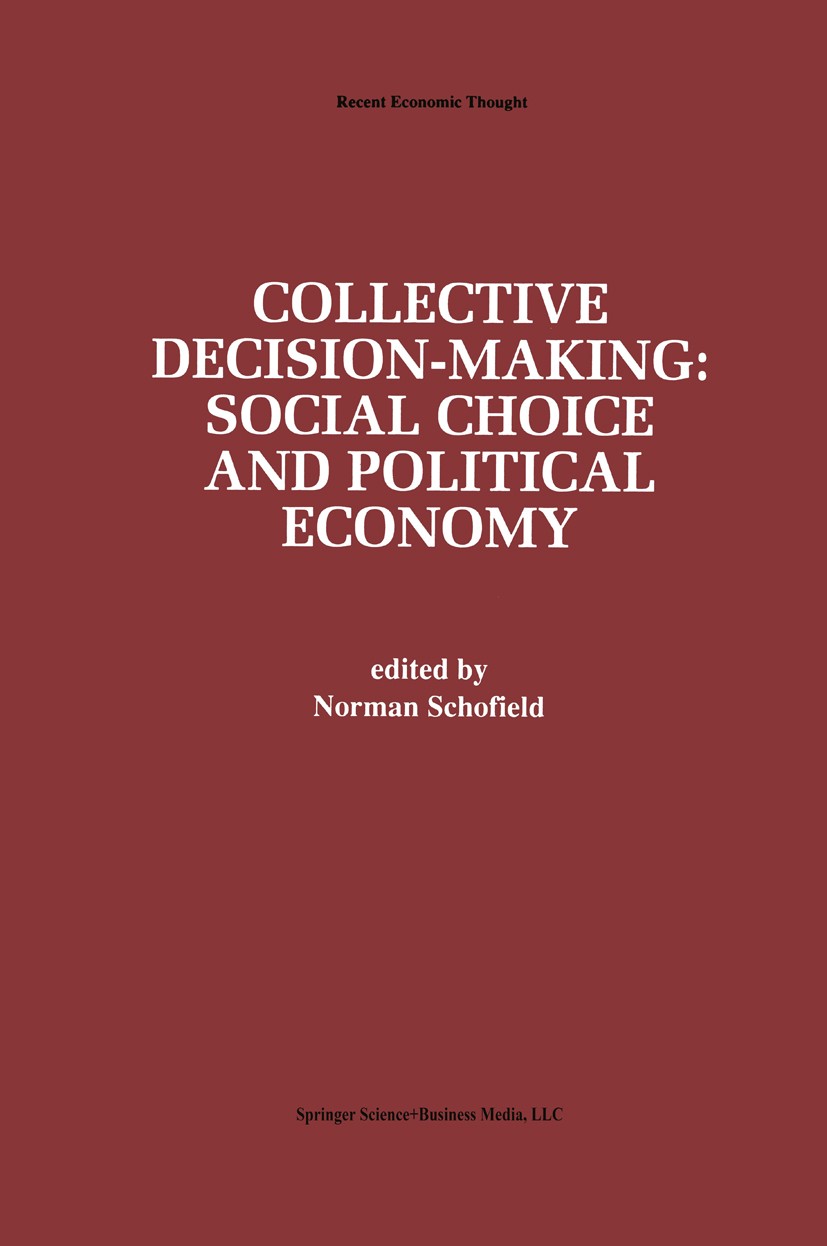 |
| 描述 | In the last decade the techniques of social choice theory, game theory and positive political theory have been combined in interesting ways so as to pro- vide a common framework for analyzing the behavior of a developed political economy. Social choice theory itself grew out of the innovative attempts by Ken- neth Arrow (1951) and Duncan Black (1948, 1958) to extend the range of economic theory in order to deal with collective decision-making over public goods. Later work, by William Baumol (1952), and James Buchanan and Gordon Tullock (1962), focussed on providing an "economic" interpretation of democratic institutions. In the same period Anthony Downs (1957) sought to model representative democracy and elections while William Riker (1962) made use of work in cooperative game theory (by John von Neumann and Oscar Morgenstern, 1944) to study coalition behavior. In my view, these "rational choice" analyses of collective decision-making have their antecedents in the arguments of Adam Smith (1759, 1776), James Madison (1787) and the Marquis de Condorcet (1785) about the "design" of political institutions. In the introductory chapter to this volume I briefly describe how some of the cu |
| 出版日期 | Book 1996 |
| 關(guān)鍵詞 | Policy; economy; monetary policy; political economy; politics; social choice theory |
| 版次 | 1 |
| doi | https://doi.org/10.1007/978-94-015-8767-9 |
| isbn_softcover | 978-90-481-5800-3 |
| isbn_ebook | 978-94-015-8767-9Series ISSN 0924-199X |
| issn_series | 0924-199X |
| copyright | Springer Science+Business Media B.V. 1996 |


 |Archiver|手機版|小黑屋|
派博傳思國際
( 京公網(wǎng)安備110108008328)
GMT+8, 2026-1-31 05:21
|Archiver|手機版|小黑屋|
派博傳思國際
( 京公網(wǎng)安備110108008328)
GMT+8, 2026-1-31 05:21






 發(fā)表于 2025-3-21 18:19:59